
Access the full conversation with Dr. Glenn D. Steele Jr. below.
What does it take to transform a healthcare organization? For Dr. Glenn D. Steele Jr., former President and CEO of Geisinger Health System, it starts with a strategic goal the organization is uniquely positioned to reach and the discipline to keep that goal in view.
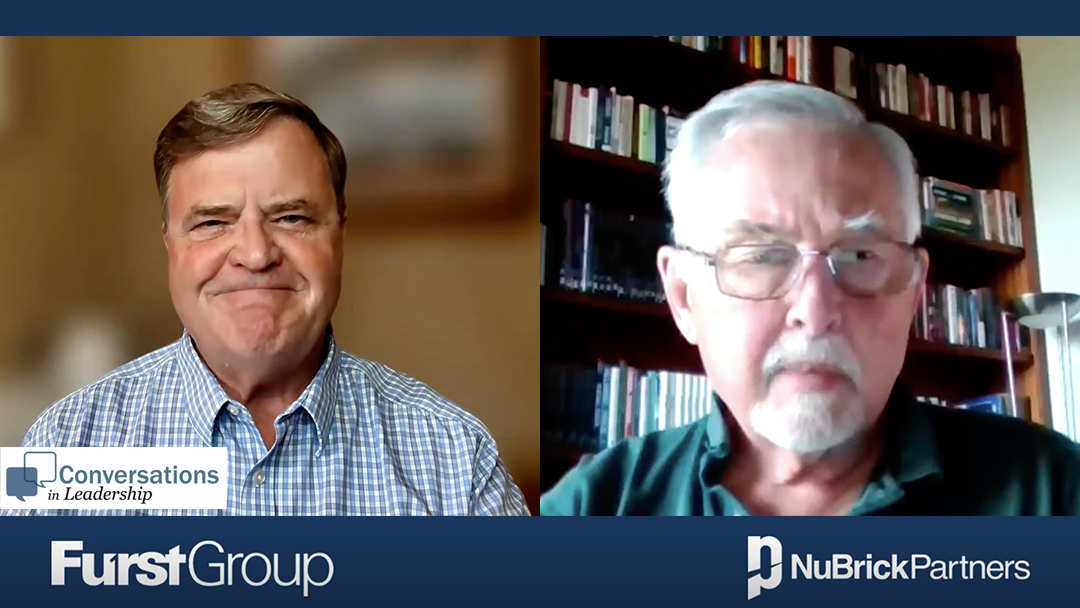
Glenn spoke with Bob Clarke, Chairman of Furst Group and NuBrick Partners, for a special edition of Conversations in Leadership featuring past recipients of the Gail L. Warden Leadership Excellence Award. He reflected on his work at Geisinger and what it means for the leaders coming up behind him. His reflections center on the value system behind effective leadership, the discipline of strategic focus, the continuing shift to outcome-based reimbursement, and the role of education in better health outcomes.
In 2014, Glenn received the Gail L. Warden Leadership Excellence Award from the National Center for Healthcare Leadership (NCHL), sharing the honor with Nancy M. Schlichting. NCHL recognized him for seeking better patient outcomes while reducing the total cost of delivering medicine.
How Geisinger Aligned Payer and Provider to Lower Total Cost of Care
Asked what stands out as his most significant leadership accomplishment, Glenn pointed to Geisinger and its ability to show that insurance companies and provider groups could work together to benefit a mutual constituency. Geisinger had a payer organization and a provider organization within the same fiduciary, which allowed the two to work toward the same outcome.
“We had a demography that was very stable, with a huge amount of prevalent chronic disease,” Glenn explained.
In that setting, Geisinger showed that the right information flow, incentives, and feedback could improve chronic disease management while lowering total cost of care.
“I am most proud of the fact that we established a really sustainable business model that, with information flow and with the right incentives and the right feedback, showed that we could, working together, decrease total cost of care by improving the outcome of chronic disease management,” he said. “It was a big deal and a transformative change even at Geisinger.”
Hear Dr. Glenn D. Steele Jr. describe the business model he is most proud of from his time at Geisinger.
The harder question, he acknowledged, is whether that model can scale. “Now, subsequently, the big experiment is, can you scale that? Can you scale that to other parts of the country? Can you scale it to organizations that don’t have both payer and provider in the same fiduciary?” he said. “It’s not easy, but at least I think the model was shown to be workable in that unusual context.”
Why Character Matters Most in Healthcare Leadership
When Bob asked what essential trait he hopes the next generation of leaders brings to the table, Glenn’s answer had nothing to do with strategy documents or financial models. “I’d like to see emerging leaders maintain a very fundamental positive value system,” he said.
That value system matters all the more, he noted, at a time when so many role models, mainly outside healthcare, will do anything to reach a certain endpoint. For Glenn personally, the most important leadership trait is “a commitment to honesty, a commitment to benefiting the people that we’re actually responsible to, which is the population that’s trying to maintain its health or get the best healthcare possible.”
That commitment extends to how decisions get made. “To make sure that what we do is evidence-based, to be able to project confidence to those that we serve, but at the same time really understand that nothing that we’re doing now cannot be improved,” he said. “I believe that character matters, and for me, character comes down to the fundamental value system of the individual leader.”
Hear Dr. Glenn D. Steele Jr. describe the leadership trait he considers most important.
Strategic Focus: Glenn’s One Piece of Advice for Emerging Leaders
Asked for one piece of advice for emerging leaders, Glenn began by acknowledging the pressure every generation of leaders feels. “Everybody at the particular time and the moment in time when they’re leading basically feels that it’s never been more challenging,” he said. “But it has been, and it will be.”
“For leaders that actually want to transform something, that actually want to make a difference over time, for me, the single most important thing is to have a strategic goal and to maintain that strategic goal.”
Hear Dr. Glenn D. Steele Jr. share the single most important thing for leaders who want to make a difference over time.
The right goal looks different for every institution, geography, and fiduciary structure. Glenn’s advice is to find what the organization can do better than any other because of its structure and context, then protect that goal from the pull of daily emergencies.
“If you can figure out what, as a leader of an organization, that organization can do better than any other organization, not because it’s working harder or has better people, but it’s just because of the structure and the context and the people who are served. If you could figure out one or two things strategically that you want to aim for, and then not get totally preoccupied by the moment-to-moment emergencies, that would be my single piece of advice,” Glenn said.
When Bob noted how hard that is to do, especially now, Glenn agreed. “It really is,” he said. “But you got to do it.” Without that focus, he explained, even well-meaning, hardworking leaders can be pulled off course.
“You’ve got to be appropriate in terms of your big, hairy goal, but you’ve really got to figure out how to keep your eye on that big, hairy goal, otherwise you’ll just get nickel-and-dimed by the emergency of the moment,” he said. “I think that’s what happens to a lot of good people who are well-meaning, work hard. They just don’t have the ability or they don’t have the structure around them to keep their eye on that big strategic goal.”
Hear Dr. Glenn D. Steele Jr. explain why leaders need to keep their eye on the big strategic goal.
Why the Shift to Outcome-Based Reimbursement Will Continue
When Bob described this as a uniquely challenging era for healthcare, Glenn offered a longer view. “I think it always has been,” he said.
“The fundamentals, regardless of the administration that’s in power at the time… the fundamentals are still moving from reimbursement based on units of work to reimbursement based on outcome,” he said, pointing to value-based care and population cohorts. “That’s an inevitable and continued change.”
That makes it a theme every organization should plan around, figuring out how to use its particular structure and ability to meet that reality.
Scaling New Knowledge to the Clinicians Who Deliver Care
Glenn also spoke about his involvement in the governance of City of Hope, where he has served as chair of the board. From that vantage point, he described the steady flow of new information on the most prevalent cancers.
“There’s new information that’s applicable to new ways of caring for every kind of cancer. And the key thing is how do you scale that to people who are out there trying to give care,” he said. “There’s no way those men and women can keep up with all that information in the old-fashioned memorization kind of thing that we used to do at medical school. They’ve got to be able to use information sources and new knowledge entities in order to know what to do for lung cancer or for breast cancer, for prostate cancer, for colon cancer.”
Rather than viewing this challenge as overwhelming, Glenn framed it as opportunity. “You can look at that and be overwhelmed by the challenge. But obviously, for those of us who are still in the game, we look at that as a real interesting ceiling to strive towards,” he said.
Why Education Is Essential to Better Health Outcomes
Asked about his biggest hope for healthcare in this country, Glenn connected health outcomes to the broader state of education. “Unless there’s a significant improvement in our educational system across the board, I don’t think we’re going to be able to achieve the health outcomes that we want,” he said.
“There’s always been an asymmetry between those who give the care and those who get the care,” he explained. “We now have this amazingly efficient way of transmitting information and misinformation, but without having a better educated group of people who are receiving the information, it becomes chaotic.”
For Glenn, the stakes reach beyond healthcare. “I think the better education of our citizenry writ large is important not only for health outcomes, but as far as I can see it, it’s critical for the maintenance of our democracy,” he said.
What Healthcare Leaders Can Take From Glenn’s Approach
Glenn’s reflections offer a few clear takeaways for healthcare leaders at every stage. Ground leadership in a fundamental value system built on honesty and a commitment to the people the organization serves. Make decisions that are evidence-based, and stay open to improvement. Commit to a strategic goal that fits the organization’s structure and the people it serves, and defend it against the emergencies of the moment.
He also modeled a mindset that matters as much as any strategy. “I just think that people who lead, despite all of the challenges, have to believe that there are opportunities in those challenges,” he said. Leaders who don’t, he added, “probably ought to retire and play golf and go to Scotland.” It isn’t a path he plans to take. “I love all those things, Bob, but I’d be bored as heck if I weren’t still in the game.”
Hear Dr. Glenn D. Steele Jr. explain why leaders have to believe there are opportunities in their challenges.
“I’m still positive,” Glenn said. “Because I think human nature is very plastic, and I think with the right leaders, it’s amazing what people can be enabled to accomplish.” His reflections point to a steady formula for transformative leadership: identifying the right strategic goal for a specific organization, holding to a foundation of honesty and evidence, and staying focused on that goal even as daily emergencies compete for attention. As Glenn put it, “Leadership is critical.”
Access the Full Conversation
Bob Clarke, Chairman of Furst Group and NuBrick Partners, in conversation with Dr. Glenn D. Steele Jr.,
former President and CEO of Geisinger Health System.
About
Dr. Glenn D. Steele Jr.:
Glenn D. Steele Jr., MD, PhD, served as President and CEO of Geisinger Health System from 2001 to 2015 and received the Gail L. Warden Leadership Excellence Award in 2014. Before Geisinger, he was dean of the Biological Sciences Division and the Pritzker School of Medicine at the University of Chicago. He is Chairman of GSteele Health Solutions and Immediate Past Chair of the City of Hope Board of Directors, which he chaired beginning in 2020.
The Gail L. Warden Leadership Excellence Award:
Presented by the National Center for Healthcare Leadership (NCHL), the award honors Gail L. Warden, NCHL’s founding chair and President Emeritus of Henry Ford Health. It celebrates individuals who have driven meaningful, enduring improvements in health and healthcare through visionary leadership and a strong commitment to the wellbeing of their communities.
Conversations in Leadership:
Conversations in Leadership is our series featuring candid perspectives from healthcare leaders, hosted by Bob Clarke, Chairman of Furst Group and NuBrick Partners. In a special edition of the series, Bob, who serves on the NCHL Board of Directors, connects with past recipients of the Gail L. Warden Leadership Excellence Award to reflect on the decisions, challenges, and lessons that define great leadership.