
Access the full conversation with William H. (Bill) Nelson below.
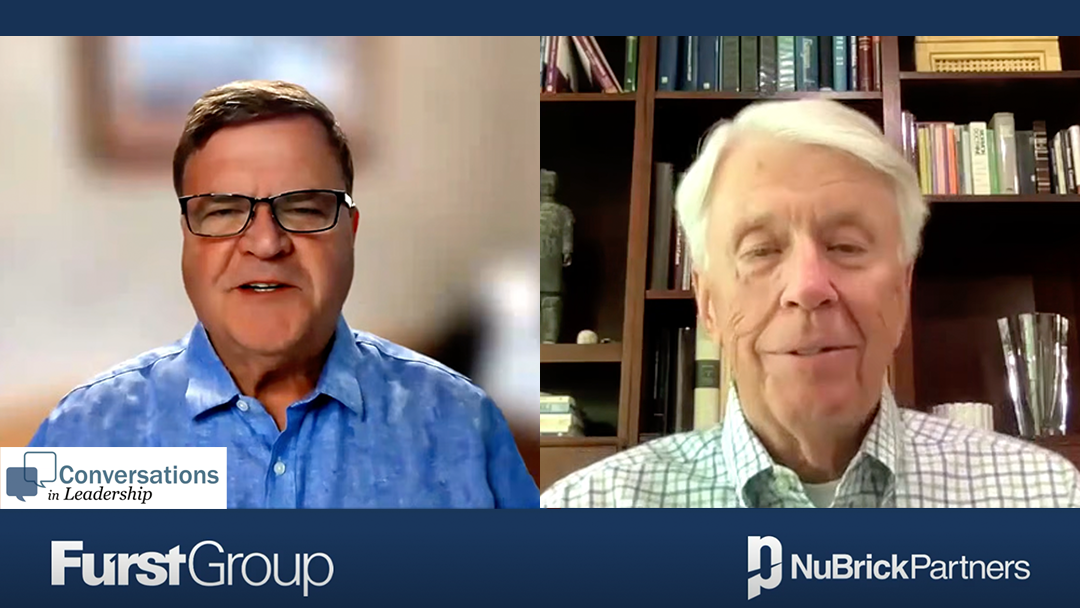
What does great health system leadership look like over the long term? For William H. (Bill) Nelson, former President and CEO of Intermountain Health, the answer begins with mission and the people gathered around it.
Bill spoke with Bob Clarke, Chairman of Furst Group and NuBrick Partners, for a special edition of Conversations in Leadership featuring past recipients of the Gail L. Warden Leadership Excellence Award. He reflected on the principles that guided his more than three decades at Intermountain. His reflections center on three connected ideas: mission as the foundation for decisions, teams built on shared ownership, and a close understanding of the communities an organization serves.
In 2005, Bill became the first recipient of the award. Presented by the National Center for Healthcare Leadership (NCHL), it honors NCHL’s founding chair and celebrates individuals who have driven meaningful, enduring improvements in health and healthcare through visionary leadership and a strong commitment to the wellbeing of their communities.
These themes are familiar in healthcare leadership conversations. What makes Bill’s perspective valuable is the clarity with which he connects them and the conviction that comes through when he describes what worked during his years at Intermountain.
Why Mission Comes First for Healthcare Leaders
When asked what trait he most hopes to see in emerging healthcare leaders, Bill’s answer was direct.
“Simply a leader who is honestly, directly focused on improving the health status, improving health in the community, improving availability and excellence in healthcare services,” Bill said. “Without that objective, we won’t benefit, to the extent that we could, the people that we’ve chosen and have been asked to serve.”
That answer resonated with Bob, who connected it to what Furst Group looks for when partnering with organizations on C-Suite transitions. “In 40 years of advising boards, I’ve found that technical skills are just the table stakes,” Bob said. “You can teach a lot of things, but you can’t teach mission.”
For Bill, mission is also where the conversation ends. Asked at the close whether he had other perspectives to share, he returned to the same point. “The overarching thought that I had was what I’ve said, that mission is critical, determining what the mission of the organization is,” he said.
He was clear that the principle is not limited to not-for-profit organizations. “I think that’s not specifically focused on not-for-profit organizations,” Bill explained, “because commercial for-profit organizations, with, again, the desire to best serve the people that they’ve defined as their population of service, it ought to work the same.”
Hear Bill Nelson explain why mission applies to for-profit and not-for-profit organizations alike.
How Shared Ownership Changes Team Accountability
Asked which accomplishment he is most proud of, Bill did not point to a single initiative or outcome. He pointed to the team he built around him.
“I believe the best thing I did was to put together an incredible group of colleagues,” he said, “focused together on our mission as an organization, focused together to work together and to accomplish what we accomplished as a team.”
Hear Bill Nelson reflect on the accomplishment he is most proud of from his years leading Intermountain.
“As a team, we made decisions together and we all own those decisions,” he explained. “When things didn’t go exactly as we’d wished, there was no way to lay those … off to someone else. It was our decision. We decided, so how can we best accomplish those goals?”
This model extended well beyond Bill’s direct reports. He described a team that reached “beyond just the people that were in my reporting group, but throughout the organization,” with people involved in making decisions, carrying them out, and improving them as Intermountain learned more and set more concise objectives.
Bill was also clear that this approach was not about celebrating individual brilliance. “There were no chosen superstars. There were no chosen geniuses,” he said. “There were geniuses, but as part of a team, not acting on their own.” For healthcare organizations building strong leadership pipelines, his experience is a reminder that excellence is often a collective outcome.
Why Leaders Must Understand the Needs of the People They Serve
Bill’s third principle ties mission and teams together: leaders need a clear understanding of the people they serve.
His advice to emerging leaders was straightforward, and he framed it as advice that holds in any setting. “Build teams, focus on mission,” Bill said. “Understand the needs of the people in the area that you’re serving, specialty and geographic, and then work together to accomplish those. It’s the same script, different circumstance.”
Hear Bill Nelson share his advice for the leaders coming up behind him.
Bob called the answer “quite profound in its simplicity.” Bill’s pairing of specialty and geographic needs reflects how much healthcare needs vary from one community to the next. The principles stay constant, and how they are applied depends on the people an organization has been asked to serve.
How Board Alignment Supports Mission-Driven Leadership
Bill credited much of what Intermountain accomplished to a board that held the organization accountable to its mission. He made the point in response to Bob’s observation that mission cannot be taught.
“One of the great blessings we had at Intermountain was a board that expected that of us,” Bill said. “That’s all the board wanted to do, was improve health status, improve clinical excellence, and there was no self-service on the board.”
That alignment made the period, in Bill’s words, “a magic time in my life because the goals were united. The objective, the mission was clear, and we had people that were committed to doing that and committed to doing that as a team.”
Hear Bill Nelson describe the board that held Intermountain to its mission.
Bill Nelson’s Hope for the Future of Healthcare
Asked about his one hope for the future of healthcare in the United States, Bill looked to the system as a whole. “The hope would be that we could find enough congruence and enough desire to step back,” he said, and ask what is needed to develop a system that “meets the healthcare needs now of the country.”
“How do we structure the incentives?” he continued. “How do we pull together and develop processes and goals that will accomplish better healthcare services?” His questions reflect a challenge many healthcare leaders recognize: aligning incentives and processes so that mission guides how care is organized and delivered.
What Healthcare Leaders Can Take From Bill Nelson’s Approach
Bill’s reflections offer a useful lens for boards and executives evaluating their own leadership teams. Because mission is difficult to teach, it deserves real weight in executive selection and succession decisions. Teams that share ownership of decisions also share accountability for outcomes. And goals are most meaningful when they are grounded in the needs of the people an organization serves.
For current and future healthcare leaders, Bill’s experience is a reminder that operational excellence and mission-driven leadership reinforce each other when the board, the executive team, and the broader organization are working toward the same goals.
Healthcare boards and executive teams looking to strengthen their own leadership pipelines might start with three questions drawn from Bill’s reflections: Is our mission clear enough to guide decisions when things do not go as planned? Are our teams structured for shared ownership, or for individual credit? And do we fully understand the needs of the communities we serve?
Access the Full Conversation
Bob Clarke, Chairman of Furst Group and NuBrick Partners,
in conversation with Bill Nelson, former President and CEO of Intermountain Health.
About
Bill Nelson
William H. (Bill) Nelson is the former President and CEO of Intermountain Health in Salt Lake City, Utah. He joined Intermountain in the 1970s, spent more than three decades with the organization, and became President and CEO in 1999. In 2005, he became the first recipient of the Gail L. Warden Leadership Excellence Award.
The Gail L. Warden Leadership Excellence Award
Presented by the National Center for Healthcare Leadership (NCHL), the award honors Gail L. Warden, NCHL’s founding chair and President Emeritus of Henry Ford Health System. It celebrates individuals who have driven meaningful, enduring improvements in health and healthcare through visionary leadership and a strong commitment to the wellbeing of their communities.
Conversations in Leadership
Conversations in Leadership is our series featuring candid perspectives from healthcare leaders, hosted by Bob Clarke, Chairman of Furst Group and NuBrick Partners. In a special edition of the series, Bob, who serves on the NCHL Board of Directors, connects with past recipients of the Gail L. Warden Leadership Excellence Award to reflect on the decisions, challenges, and lessons that define great leadership.